The Droids You're Looking For
And The Absurdity of Digital Importance

Do you remember those chain emails from the 1990s that threatened your eternal soul if you didn’t forward them?
“Forward this or you don’t love Jesus!”
“If you’re a patriot and love this country, send this to 10 friends now!”
They were ridiculous then and obvious junk now, but significant as a cultural symptom. Many people treated them as though they mattered, even though they were clearly junk. They were always titled as urgent and inflated with the perception of moral consequence.
I think a lot of those instincts still govern how we behave online today. They foreshadowed the absurd things we’ve come to collectively believe about digital space.
In those days the underlying impulse was the same: information forwarded online was somehow of grave moral consequence, even if it had no basis in real importance. Today, that impulse is a cultural reflex.
In a literal sense, nothing that happens in an online comment thread actually changes the fundamental structure of reality. A tweet does not make a truth true, and a viral meme does not alter the laws of physics. Nothing about that is mysterious. It’s self-evident and obvious the moment we pause to consider it, and abstractly we don’t actually believe it to be true. But, we behave as if it were true. Therein lies the absurdity and the performative contradiction.
The cognitive energy, emotional investment, and moral weight we collectively assign to these things make it seem as if the digital sphere is a parallel (or in many cases the) universe upon which our souls and futures depend. In extreme cases, this illusion does bring to bear tragedies in reality. Look no further than recent suspects of mass shootings or the subjects of gender dysphoria whose lives became absorbed and culturally conditioned by the blob that is the matrix of digital space.
Fast forward from the email virtue-dragooning of three decades ago, and here we are responding continually, emotionally, and morally to digital signals as if they were landmarks in real history and signifiers of personal worth and importance, rather than ephemeral gestures in a machine-curated feed.
Yet we endlessly search and scroll the digital world, living and moving and having our being online, as if the next post will be the life you’re actually looking for.
This avoidance of incarnate, embodied living and friendships is one big Jedi Mind Trick:

The irony is that it’s epistemologically absurd to treat digital space (of manufactured signals, algorithmic priorities, and fragmented emotion) as if it were actually where meaning is made rather than where the illusion of meaning is sold.
Turns out, flesh and bone interactions are the droids you’re looking for…
Social Media & Living as Creatures
Our brains are shaped to respond to cues of social relevance: faces, expressions, communication, reciprocity. Social media captures those instincts and twists them into a feedback loop of immediacy and volatility. We react violently to comments, feel hurt by likes and dislikes, and make moral judgments based on posts that disappear into the void seconds later. Yet none of it constitutes actual life happening to us in the embodied world.
This is emotionally exhausting because our nervous systems think it is real. This is an insight Paul Anleitner highlights in his piece “Why Social Media is Making You Perpetually Exhausted.” The relentless stimulation with no narrative continuity or resolution leaves us mentally spent. The limbic system doesn’t know the difference between physical threat and an enraged online thread. And there’s little to no coherence whatsoever between successive posts in a feed, so the brain exhausts itself - doing what it’s created to do in trying to establish a cohesive thread and meaning between them all - failing to arrive at narrative closure. This is how we make sense of our identity amidst lived experience, and because the content within the digital interface is so disparate, it fragments identity within the brain and nervous system.
Ben Christenson, in his writing at Living as Creatures, puts it in a broader cultural frame: we are not merely interacting with technology, we are being shaped by it. Algorithms don’t just fetch content that matches our tastes; they reinforce and reshape those tastes to maximize engagement. That means insecurity and impulsive reactions become the most profitable emotional states, and thus the ones constantly served to us.
This is why it isn’t just distraction. It’s a subtle erosion of the modes and standards by which we judge truth, meaning, identity, and reality.
Let’s be clear: digital space is practically important because people treat it as if it matters. But it doesn’t actually matter in an ontological or existential sense. Numbers of followers and subs neither equate to human connection nor make content true or meaningful. Emotional investment in an online fight does not shape the moral arc of anyone’s life except through how we let it affect our interior peace. Again, while this is self-evident most still behave in such a way as if it was true, signifying (a false) moral import by allowing it to have formative effect.
Christenson has written about this distortion as part of our “machine age” reality: a culture built on responding to impulses, reacting to the next notification, and producing content as the principal form of engagement with the world we live in.
The twist is that the digital realm doesn’t just distract us from what’s real, it converts us into products for the attention economy. Christenson’s critique in The Demon in the Machine is blunt: technology externalizes identity and loops it back to be monetized, turning even our inner lives into signals for the machine’s profit.
It’s like the friend of mine in college who used to refer to television screens as “the whore of attention.” Screens sell intimacy without relationship. They offer the feeling of engagement while quietly extracting devotion.
Our Mission
To be clear, I’m not calling for a flight from digital space. The “cat’s outta the bag” and there’s no putting it back (unless the grid collapses). As Christians, our mission is clear: we must bring the light of the Logos to the darkness. This is what Jesus meant when He tells Peter that the gates of Hades shall not prevail against the Church (Mt 16:18).
There was deep symbology to the location context in which Jesus said this. Caesarea Philippi was a city known for its intense pagan worship and a massive cave with a spring believed by locals to be a physical, literal entrance to the underworld. Striking backdrop to His words.
Hades, the Greek god of the underworld and a name for the realm of the dead, is used elsewhere in Scripture as a term for the grave or hell (Psalm 9:17; 55:15; 116:3). In Matthew 16 Jesus uses it with three-fold meaning. First, to describe the powers of evil arrayed against Him, including Satan and death itself. When he speaks of its “gates” He is pointing to the organized forces of darkness that resist God’s kingdom. Secondly, through his death and resurrection, Jesus defeats Satan, and His people share in that victory. Thirdly, we must confront the “gates of hell” (Satan’s kingdom of darkness) in our culture - those places dominated by evil because of the lack of His light and truth. Jesus is declaring that death and evil are no match for the power of the Gospel and the community of believers He is building.
If the practical meaning of this for us today is to bring the Good News to the digital (under)world, then for the Luddites among us, our curmudgeony selves have to step outside this:

and take the fight to this:
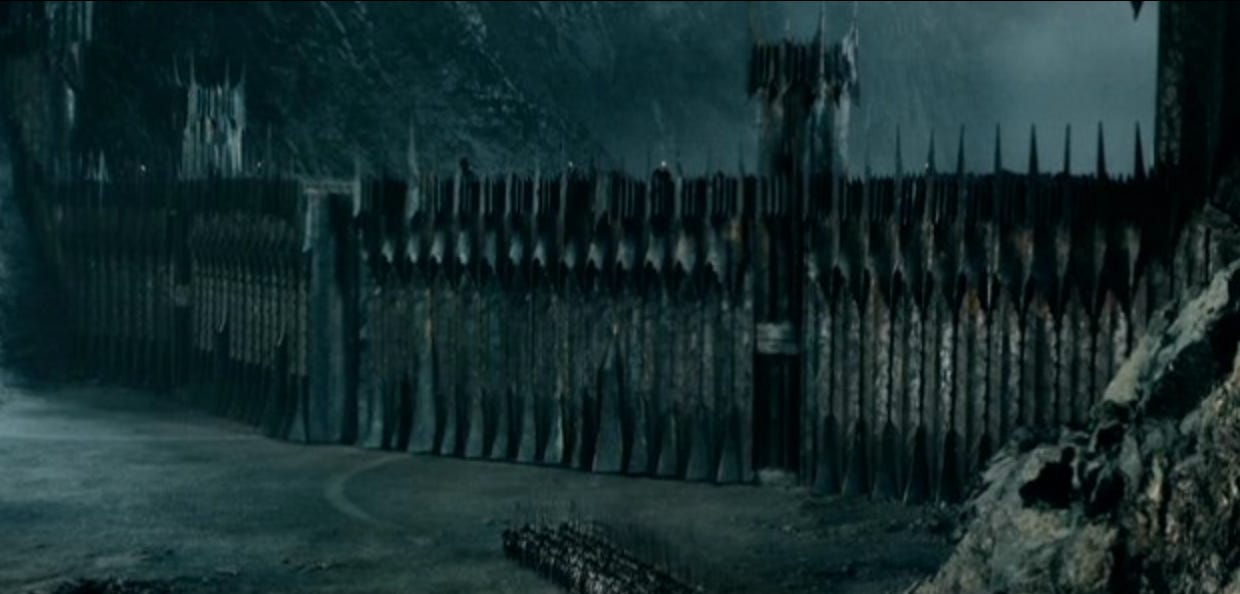
In Sum
There’s a surprising connection here between Jesus’s words in Matthew 16 and Plato’s Republic.
-Jesus (to his pals, the Apostles) —> the gates of Hades won’t prevail against you = take the Light down into the cultural “pits of hell.”
-Socrates (with his pals) —> goes “down to the Piraeus” so as to rally some interlocutors and “ascend” to Athens.
Plato, from the Republic’s opening line, is winking at The Allegory of the Cave that will come in Book VII. The connection between these opening words and the necessity of the philosopher to return back down into the cave after being exposed to reality is clear. The entire dialogue is a performative utterance.
—
The heart of the matter is that we treat screens, algorithms, and digital reactions as if they are ecumenical councils convening truth, yet they are fundamentally arbitrary and engineered for the enslavement of our attention.
We’re like the Israelites in relapse,
“Leave us alone that we may serve our screens. For it would have been better for us to serve our screens than to die in the wilderness of embodied existence!” - Exodus 14:12 (my remix)
Or:
We “are anxious and troubled about much online content, but one thing is necessary…” - Luke 10:41-42 (my remix):
So what are we to make of this fundamental and complete exploitation of our psychology that we, from a behavioral standpoint, enthusiastically participate in?
While I’m still trying to figure that out, for the time being, engaging in online life still feels like disembodied impulses reacting to shadows on a wall.
Yes, the philosopher goes back down into the cave, but only after he has seen the sun. The Church walks toward the gates of Hades, but only because Christ has already walked out of them.
Maybe the antidote to digital unreality is neither rage-posting nor retreat. Instead, maybe it’s books, dinner tables, eye contact, kneeling in prayer, and real laughter in a real room with real people. After all, we can say with Pinocchio,

The screens are not the droids you’re looking for.
Your neighbor is. Or your elderly grandparent, who might benefit (more than anyone else in your life) from a phone call, letter, or in-person visit.
The next time the feed makes it feel that everything happening in that glowing rectangle is urgent, remember that the Word became flesh, not a notification.